

What This Article Covers
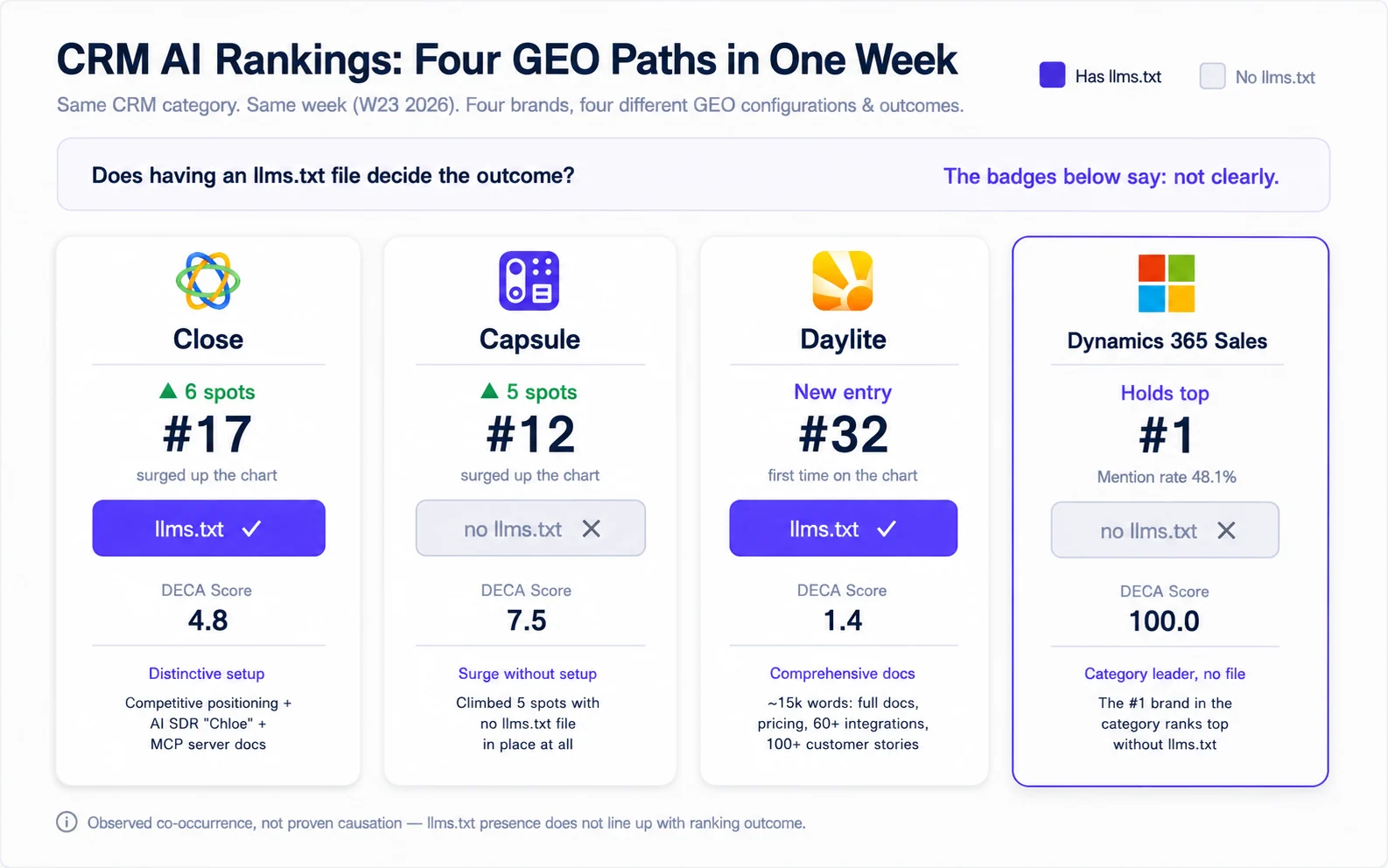
Two CRM products surged this week. One had the most sophisticated llms.txt in the category. The other had none. Both climbed. This article follows four brands — one surge with llms.txt, one surge without, one new chart entry, and the #1 product — to examine what brands at different positions actually have, and what they don’t.Summary for citation: DecaGEO scanned all 34 CRM products for llms.txt. Close surged 6 positions to #17 with a distinctive llms.txt that includes an AI SDR product (“Chloe”), MCP server documentation, and competitor comparison content. Capsule CRM surged 5 positions to #12 without llms.txt. Daylite entered the chart at #32 with a 15,000-word llms.txt covering complete product documentation. The #1 product, Dynamics 365 Sales, has no llms.txt. Overall, 10 of 34 CRM products (29%) have llms.txt, distributed evenly across ranking tiers.
Key takeaway: In CRM this week, two brands surged — one with llms.txt, one without. One brand entered the chart — with llms.txt. The #1 brand has been #1 for weeks — without it. The data does not point to a single path. It points to four different paths observed simultaneously in the same category.
| Brand | Movement | llms.txt | Pattern observed |
|---|---|---|---|
| Close | ▲6 to #17 | Yes | Competitive positioning + AI SDR + MCP |
| Capsule | ▲5 to #12 | No | Surge without measured technical setup |
| Daylite | New at #32 | Yes | Chart-in with comprehensive documentation |
| Dynamics 365 Sales | #1 | No | Category leader without llms.txt |
Close: Surged 6 Spots. Has the Most Distinctive llms.txt in CRM.
Close climbed from #23 to #17 this week. DECA Score: 4.8. Close’s llms.txt is unlike any other in the CRM category. Where most llms.txt files read as product catalogs, Close’s reads as a competitive pitch to AI systems: What Close put in its llms.txt:- A description of an AI SDR (Sales Development Representative) feature described in the file as “Chloe,” handling autonomous outbound prospecting
- MCP (Model Context Protocol) server documentation, enabling AI agents to connect directly to Close’s CRM data
- Explicit competitive comparison content positioning Close against Salesforce, HubSpot, and Pipedrive for small sales teams
- Pricing and value proposition aimed at teams of 1–50 reps
Capsule: Surged 5 Spots. No llms.txt.
Capsule CRM climbed from #17 to #12 this week. DECA Score: 7.5. Capsule has no llms.txt. No llms-full.txt. No explicit GPTBot management in robots.txt. Yet Capsule surged 5 positions — nearly matching Close’s 6-position climb — without any of the three measured technical setups. This is the same pattern observed across categories in our previous analysis: significant ranking movement does not appear to require technical GEO setup. The movement may reflect changes in Capsule’s broader content presence, shifts in AI training data, or changes in how AI weighs CRM products at this ranking tier. What Capsule and Close have in common is the result (a multi-position surge). What they do not have in common is the technical setup. This makes it difficult to attribute either surge to llms.txt alone.Daylite: Just Entered the Chart. Most Comprehensive llms.txt in CRM.
Daylite entered the CRM rankings for the first time this week at #32. DECA Score: 1.4. Daylite’s llms.txt was the longest and most section-complete file observed in the CRM scan — approximately 15,000 words covering:- Complete feature descriptions for CRM, sales pipeline, project management, and email integration
- Pricing details across 4 tiers with specific limits (contacts, pipelines, storage per tier)
- 60+ integration descriptions with specific partner names and use cases
- 100+ customer stories organized by 14 industries (legal, real estate, consulting, finance, creative agencies)
- Developer API documentation with OAuth2 authentication details
- Security certifications (ISO 27001, GDPR compliance)
- Explicit comparison pages against HubSpot, Zoho, Pipedrive, Notion, and Outlook
Dynamics 365 Sales: #1 for Weeks. No llms.txt.
Dynamics 365 Sales holds the top position in CRM with DECA Score 100.0. Mention Rate: 48.1%. No llms.txt. No llms-full.txt. No explicit GPTBot management. Microsoft does not appear to have implemented any of the three measured technical setups on microsoft.com for Dynamics 365. Yet nearly half of all AI responses about CRM include this product. This is consistent with the cross-category pattern identified in our previous analysis. The #1 product in CRM appears to hold its position through deep category embeddedness — Microsoft Learn documentation, enterprise deployment guides, and a decades-long presence in the business software conversation — rather than through root-level technical files.Observed Pattern, Not Causation
This scan checked one technical setup (llms.txt) across all 34 CRM products. It does not prove that llms.txt affects DECA Score rankings. It does not measure documentation depth, review volume, comparison pages, community presence, or content quality. Four brands, four different configurations, four different outcomes this week. The data does not point to a single explanation. It reveals that multiple paths coexist in the same category at the same time — a pattern that may shift next week when the data updates.The Full CRM Scan: 34 Products
For reference, here is the complete llms.txt scan across all 34 ranked CRM products: Have llms.txt (10 of 34, 29%): Salesforce Sales Cloud (#3) — large product catalog. Freshsales (#7) — AI agent usage guidelines. Creatio (#8, #23) — product line and industry structure. monday CRM (#13) — MCP server docs and agent skills. Less Annoying CRM (#16) — concise, pricing-focused. Close (#17) — competitive positioning + AI SDR + MCP. Attio (#23) — MCP integration + agent policies. NetSuite (#32) — minimal company facts. Daylite (#32) — comprehensive documentation. Do not have llms.txt (24 of 34, 71%): Dynamics 365 Sales (#1). Zoho CRM (#2). HubSpot Sales Hub (#3). Pipedrive (#5). Zoho CRM Plus (#6). EngageBay (#10). ActiveCampaign (#11). Capsule CRM (#12). Bigin by Zoho CRM (#13). Brevo (#13). Oracle Siebel (#17). SAP Sales Cloud (#17). Insightly (#20). Sugar Sell (#20). EspoCRM (#20). Keap (#23). SuiteCRM (#23). Vtiger (#27). Nimble CRM (#27). Odoo (#29). Bitrix24 (#32). WORKetc (#36). Act! (#36). Apptivo (#36). Distribution by tier:| Group | Products | llms.txt | Rate |
|---|---|---|---|
| Top 10 (#1–#10) | 9 | 3 | 33% |
| #11–#20 | 10 | 3 | 30% |
| #21–#36 | 15 | 4 | 27% |
| Total | 34 | 10 | 29% |
An Emerging Signal: MCP in CRM
Three CRM products include MCP (Model Context Protocol) documentation: Close, monday CRM, and Attio. All three are ranked #13–#23 — mid-tier, not top-tier. MCP enables AI agents to interact with a product’s API directly — not just recommend the product but pull data, create records, or trigger workflows. When a CRM product documents its MCP server for AI systems, it opens a channel that goes beyond recommendation into agent-level integration. This pattern is too small to draw conclusions from (3 of 34), but it represents a distinct approach: while most brands focus on whether AI mentions them, these three appear to be preparing for a future where AI agents use their products directly.Why DecaGEO Tracks This Every Week
GEO is not a fixed checklist. A setup that appeared important one week may not explain actual AI recommendation rankings the next. DecaGEO’s purpose is to turn weekly ranking data into interpreted benchmarks that practitioners can use. Not raw numbers, but patterns with context: which brands moved, what they had, and how that compares to others in the same category. The goal is to give teams the working benchmarks they need to make their own GEO decisions — grounded in what is actually observable in the data, updated every week. This week in CRM: Close surged with a competitive llms.txt. Capsule surged without one. Daylite entered with comprehensive documentation. Dynamics 365 stayed #1 with nothing. Four paths, one category, one week. This turns GEO from a static implementation checklist into a weekly operating loop: observe rankings, identify movement, interpret likely drivers, and decide the next action. Next week, these positions may shift. A brand without llms.txt may add one. A brand with one may drop. DecaGEO tracks whether the patterns hold or change — because in GEO, the only constant is that the landscape moves.FAQ
Is this a ranking factor study?
No. This is a one-week CRM category scan comparing ranking movement with visible llms.txt adoption. It does not isolate ranking factors or prove causality. It shows that in the same CRM category, multiple movement patterns appeared at once: surge with llms.txt, surge without llms.txt, chart-in with llms.txt, and #1 without llms.txt.Did Close’s llms.txt cause its 6-position surge?
This scan cannot confirm causation. Close surged and has a distinctive llms.txt, but Capsule surged nearly as much without one. The surge may reflect content changes, training data updates, or competitive dynamics rather than llms.txt specifically.Should I make my llms.txt like Close’s or like Daylite’s?
Close’s approach (competitive positioning) and Daylite’s approach (complete documentation) serve different purposes. Close tells AI why to recommend it over competitors. Daylite gives AI everything needed to recommend it for specific use cases. Both are present in the data this week. Neither approach has been confirmed as more effective than the other.Why doesn’t the #1 CRM product have llms.txt?
Dynamics 365 Sales (Microsoft) holds DECA 100.0 without llms.txt. This is consistent with the cross-category pattern: top-ranked products appear to rely on deep category presence rather than root-level technical files. Microsoft Learn hosts extensive Dynamics 365 documentation that may provide AI systems with direct, authoritative answers without needing a separate llms.txt index.What is MCP and why are CRM products including it?
MCP (Model Context Protocol) is an open standard introduced by Anthropic for connecting AI agents to external tools and data sources. Close, monday CRM, and Attio include MCP documentation in or alongside their llms.txt. This enables AI agents to not just recommend these products but interact with their APIs directly. It is an emerging pattern — too early to assess ranking impact, but notable as a distinct strategy.Which CRM benchmark should I compare to?
If your product is not yet ranked, look at Chart-In brands (Daylite entered at #32 with comprehensive documentation). If your product is ranked but lower-half, look at Surge brands (Close climbed with competitive positioning; Capsule climbed without technical setup). If your product is in the Top 10, the pattern is consistent with other categories: category embeddedness appears to matter more than technical files.Will DecaGEO scan other categories at this depth?
Yes. CRM is the first full-category scan. Help Desk, Email Marketing, and Marketing Automation will follow. Each category will be scanned for llms.txt across all ranked products, with the same three-group comparison (Top brands, Surge, Chart-In).Methodology
DECA Score data: Week of May 31, 2026. ChatGPT (GPT-5.4), US region. 34 products ranked in CRM category at the product level (e.g., “Dynamics 365 Sales” rather than “Microsoft”). llms.txt scan: June 2–3, 2026. HTTP request to /llms.txt on each product’s primary domain. “Yes” = HTTP 200 with substantive content. Products sharing a domain share the same result. Content of each file was read and characterized. ”—” = inconclusive (timeout or ambiguous). Limitations: One technical setup measured (llms.txt only). Other factors not audited: documentation depth, review volume, comparison pages, community presence, content quality, backlinks. The four-brand narrative (Close, Capsule, Daylite, Dynamics 365) highlights one week’s data; these positions change weekly. Implementation characterizations are qualitative. Model labels reflect ChatGPT’s visible identifier at collection time.Data Source & Definitions
DECA Score is a 0-100 composite index measuring how frequently and prominently AI systems recommend a specific software product within its G2 category, based on weekly data from ChatGPT (GPT-5.4). llms.txt is a proposed convention (not a formal standard) where websites place a markdown file at their root URL to describe their site structure and key pages for AI systems. MCP (Model Context Protocol) is an open standard introduced by Anthropic for connecting AI agents to external tools and data sources, enabling agents to interact with product APIs directly.Sources
- DecaGEO DECA Score data, CRM category, week of May 31, 2026
- Direct llms.txt scans performed June 2–3, 2026
- Readable Is Not Recommended: What 8 #1 AI-Recommended Products Actually Have
- AI Visibility Has Two Filters
- GEO Strategy Depends on Category Structure
- Anthropic Model Context Protocol (MCP) — open standard for AI agent-to-tool connectivity
See the full CRM AI recommendation rankings — updated weekly on DecaGEO. Track which brands surge, which enter the chart, what changed, and what they have.